
Electric Gates
Everything Worth Knowing
Which type suits your entrance, what the materials actually mean in practice, how the automation works, and what the law requires. Written by people who make gates rather than sell them, and honest about the things that catch buyers out.
What are electric gates?
Electric gates — also called automated or motorised gates — are driveway or entrance gates fitted with a motor that opens and closes them without anyone getting out of the car. They are operated by remote fob, keypad, intercom, a vehicle detection loop set into the driveway, or a smartphone app.
The gate and the automation are two separate purchases that happen to arrive together. The gate is a piece of fabricated metalwork; the automation is a motor, a control board and a set of safety devices. They are specified independently, and a good installation gets both right — a well-made gate on an undersized motor fails just as surely as a cheap gate on a good one.
If you already have gates, you may not need new ones at all. Automating existing gates is possible where they are structurally sound and the posts will carry the load, and it typically costs around half what a new automated installation does.
Choosing the right gate type
Almost everyone starts by thinking about how the gate will look. The more useful starting point is how it will move, because that is decided by your entrance rather than by preference — and it rules some options out before design comes into it at all.
Swing gates
Two leaves hinged to piers, opening like traditional gates. The most common residential choice, and the most versatile aesthetically. They need clear depth on the property to open into — roughly one leaf width plus clearance.
Swing gates →Sliding gates
Runs on a track parallel to the boundary, so no depth is needed at all. The answer on shallow driveways and wide openings. Needs a clear run to one side of roughly 1.1 times the opening width.
Sliding gates →Cantilever gates
Slides with no ground track at all — nothing crosses the driveway to fill with grit, leaves or snow. Suits uneven ground and hard winters. Needs about 1.5 times the opening width alongside, and costs more.
Cantilever gates →Bi-folding gates
Each leaf folds in half as it opens, halving the depth a swing gate needs. The fastest-opening type, popular on busy entrances. More moving parts, and generally dearer than an equivalent swing gate.
Bi-folding gates →And if none of them fit
Where there is no depth to swing into and no run to slide along, rising bollards are the remaining option. They need no clearance in any direction and sit flush with the ground when lowered, which also makes them considerably easier to get approved on listed and conservation-area frontages where a gate would not be.
How much space each type needs
Five minutes with a tape measure will tell you more than an afternoon of browsing. These are working guides — your fabricator will confirm at survey, but they will rule things in or out straight away.
| Gate type | Space needed | What that means in practice |
|---|---|---|
| Swing | One leaf width of clear depth, plus clearance | A 4m opening means two 2m leaves, so around 2m clear before the gate meets a parked car, a step or the house. |
| Bi-folding | Around half a leaf width of depth | Roughly 1m of depth on that same 4m opening. Useful where a swing gate is close but not quite possible. |
| Sliding | About 1.1× the opening width, to one side | Around 4.5m of clear run alongside a 4m opening — no wall, planting or parked vehicle in the way. |
| Cantilever | About 1.5× the opening width, to one side | Around 6m alongside that same opening, because the counterbalance extends past the gate itself. |
| Rising bollards | None | Nothing above ground when lowered, and no clearance needed in any direction. |
One rule applies whatever you choose: a gate must not swing outward over a public highway or footway, however quiet the road. On a shallow frontage that rules out an outward-opening swing gate entirely, and it is the single most common reason a design has to change.
Gate materials compared
Material affects appearance, weight, motor sizing, and how much attention the gate needs over its life. The weight point matters more than people expect — a heavier gate needs a bigger motor and more substantial piers, so the material decision has cost consequences beyond the metalwork.
| Material | Weight | Maintenance | Best suited to |
|---|---|---|---|
| Aluminium | Light | Very low — will not rust | Contemporary properties and coastal sites. Powder coated in any RAL colour. The lightest option, so it is easiest on motors and piers. |
| Composite | Medium | Low — no annual treatment | Anywhere a timber look is wanted without timber upkeep. Holds colour well and does not corrode, which suits exposed and coastal entrances. |
| Steel | Heavy | Moderate — needs a sound protective finish | Bespoke and traditional designs, and any gate that has to take knocks. Galvanising before powder coating extends its life considerably. |
| Wrought iron | Heavy | Moderate — watch for rust at joints | Period and listed properties, where an open traditional design sits better against brick or stone than a modern panel. |
| Timber infill | Medium to heavy | High — annual treatment | Rural and cottage properties. Our fabricators fit timber boarding into a metal frame rather than building all-timber gates, since the frame is what carries automation reliably. |
Automation systems explained
The motor and controls are specified separately from the gate, sized to its weight and to how often it will be used. Brands commonly fitted in the UK include FAAC, BFT, Nice and Came.
The motor
Hydraulic rams, electromechanical arms or underground operators for swing gates; rack-and-pinion for sliding. Underground units are the most discreet and the quietest, but they need a housing that drains — on high water table sites they are the wrong answer whatever the brochure says.
Duty cycle
A domestic motor is built for perhaps a dozen operations a day. A commercial unit may be rated for several hundred. Fitting the wrong one to a busy entrance is the most common cause of early failure, so be honest about realistic daily use.
Safety devices
Safety edges, photocells and force limitation. Legally required rather than optional, and the place a suspiciously cheap quote has usually cut corners. Covered properly in the section below.
Access control
Remote fobs, keypads, audio or video intercom, vehicle detection loops and app control. Individual user accounts are worth having — access can be granted and revoked per person rather than re-coding everything when a fob goes missing. See access control.
Power supply
A dedicated RCD-protected circuit run to the gate in armoured cable. The load is modest, but the cable must be sized for the distance. Beyond about 50 metres the trenching becomes a significant part of the cost.
Power cuts
Every system has a manual release so the gate opens by hand. Battery backup keeps it running through a short outage. Worth deciding early whether the gate should fail open or fail shut — that matters most where it is your only vehicle access.
Already have gates you like? Automating existing gates is often possible and costs roughly half what a new installation does — provided the gates are sound, the piers will carry the load, and the weight falls within an operator’s range.
Safety and planning
Safety — BS EN 12453
Every powered gate in the UK must comply. It is a legal requirement, not an upgrade, and a non-compliant installation leaves liability with the property owner rather than the installer.
In practice it means force limitation on the motor, safety edges that stop and reverse the gate on contact, and photocell beams preventing it closing on anyone in the opening. Ask for the force measurements to be documented at handover — a compliant installer will have them.
If one quote is markedly cheaper than the others, this is almost always where the difference sits. Full safety guide →
Planning permission
More often needed than most people expect. Under permitted development a gate adjoining a road used by vehicles may be no more than one metre tall, and two metres elsewhere on the boundary. One metre is roughly waist height, so the majority of driveway gates facing a road technically require consent.
Listed buildings and conservation areas need consent regardless of height, and England, Scotland and Wales each operate under separate legislation with different enforcement periods.
General guidance only — only your local planning authority can confirm your position. Full planning guide →
⚡ TYPES OF ELECTRIC GATE?
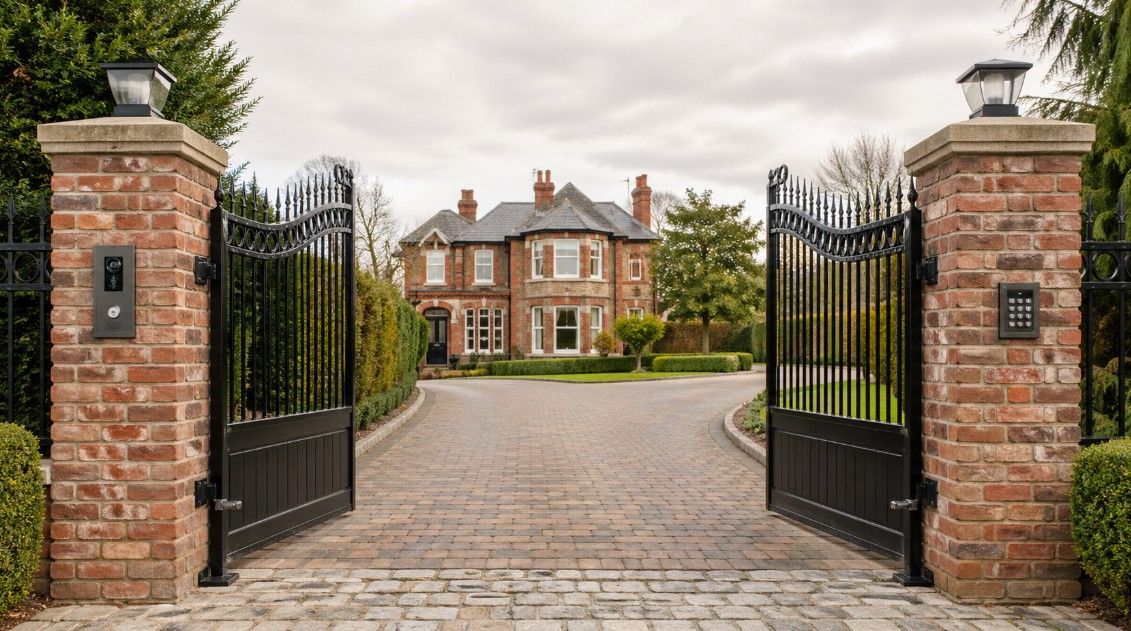
Electric Swing Gates
Two leaves hinged to pillars, opening inward or outward. The classic choice for residential driveways. Available in a huge range of materials and styles.
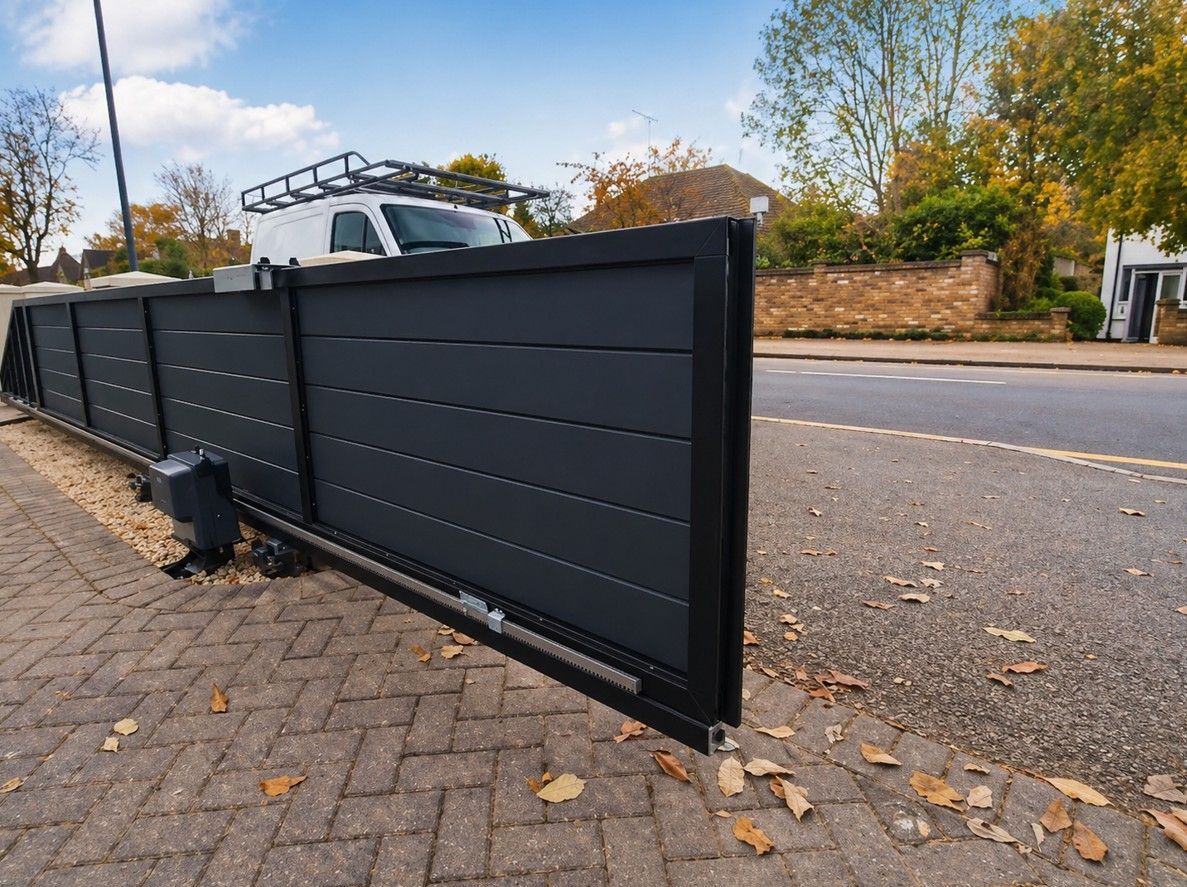
Electric Sliding Gates
Slides parallel to your fence — no swing clearance needed. Ideal for sloped driveways, narrow plots, or properties with limited depth.
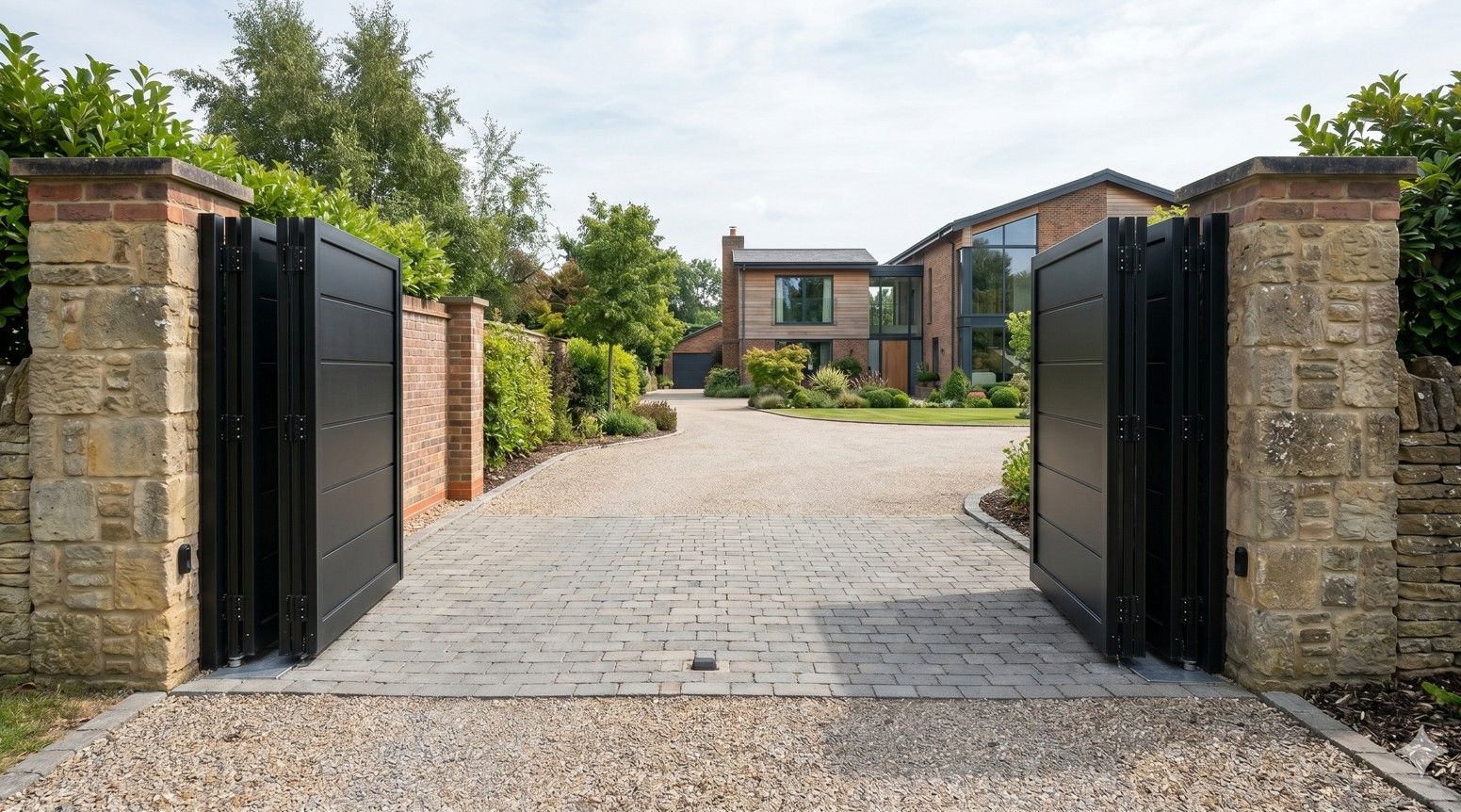
Bi-Folding Gates
Folds back quickly into a compact space - great for high-traffic entrances or plots where a standard swing or slider isn't practical.
Frequently asked questions about electric gates
How long does installation take?
Most residential installations are completed in one to two days once the gate has been fabricated. A motor retrofit to existing gates can be half a day. Projects involving new piers, trenching for cable runs or full intercom systems take two to three days. Fabrication happens before any of that, and lead times vary with workload.
What happens if the power goes out?
Every system includes a manual release so the gate can be opened by hand. Battery backup is available and worth considering where the gate is your only vehicle access, since it keeps the system running through a short outage without any intervention. A fail-safe configuration can also be set so the gate opens automatically on power loss.
Can I have gates if my entrance has no piers?
Yes. New piers can be built, or independent steel posts set to carry the gate — which is often preferred on older properties, since it keeps the load off historic brickwork or stone and the work is reversible. Where an existing wall or pier is being used, its condition needs assessing first, because automation applies far more load than a hand-operated gate ever did.
Are electric gates safe around children and pets?
A properly installed one is. BS EN 12453 requires force limitation, safety edges that stop and reverse the gate on contact, and photocell beams preventing closure on anyone in the opening. Fitted correctly these make a gate safe for a family driveway. Never accept a system without them — it is both dangerous and unlawful.
How do deliveries and bin collections work?
Worth deciding before installation rather than after. A keypad or intercom lets a courier call you, an app lets you open the gate from anywhere, and a secure parcel box outside the gate line removes the problem entirely. If your bin collection point is beyond the gate, you will want a keypad the crew can reach. A separate pedestrian gate solves most of it at once.
Will electric gates add value to my property?
Usually, particularly on detached and semi-detached homes with driveways — they add kerb appeal and security, both of which buyers respond to. How much varies considerably by property, area and how well the gates suit the house. A well-proportioned set on a period property adds more than a mismatched set on a modern estate, which can arguably detract.
Do electric gates need servicing?
Yes, at least annually. Safety edges degrade, photocells drift out of alignment and motor force creeps as components wear, so an installation compliant on day one may not be three years later. A service covers lubrication, force adjustment, safety device testing, control board checks and a structural inspection. See our maintenance guide.
Where to go from here
What it will cost
Real price ranges by gate type, and the factors that move a job within them.
Cost guide →Find your local fabricator
Every county and town we cover across England and Scotland.
Areas we cover →See real installations
Photographs of gates made and fitted by the fabricators we work with.
Our work →How we work
Independent fabricators rather than employed fitters, and what that means for you.
About ElectriGate →Ready for a price? Send your postcode, the width of your opening and a few photographs using the form below, and we will pass it to your local fabricator.