
Planning Permission
for Electric Gates
The rule most people get wrong is the height limit, and it is lower than almost anyone expects. Permitted development rules also differ between England, Scotland and Wales, so the right answer depends on where you are.
General guidance rather than legal advice. Planning rules change and interpretation varies between authorities — always confirm your position with your local planning authority before ordering.
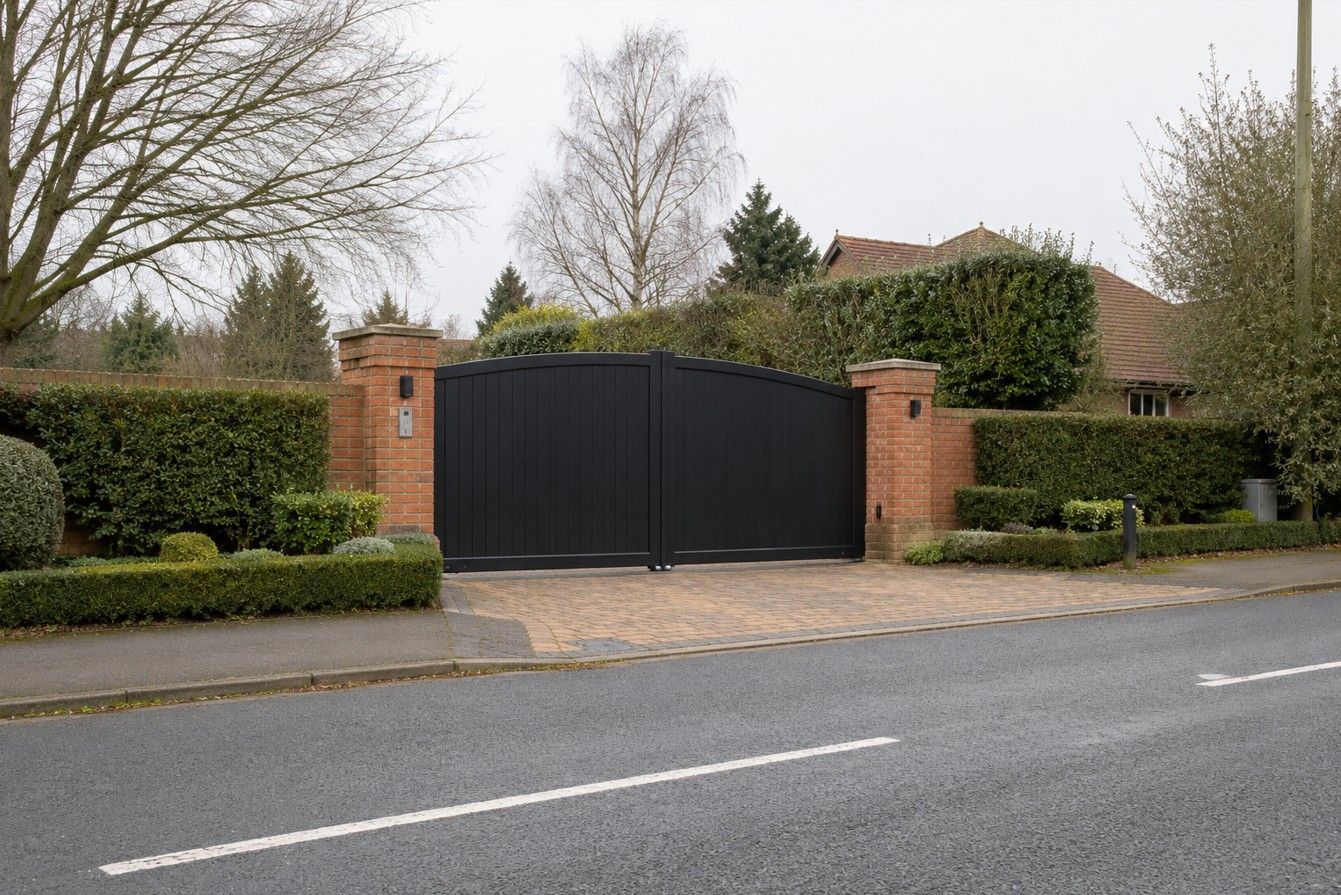
Planning permission for electric gates in England
These limits come from the Town and Country Planning (General Permitted Development) (England) Order 2015. One metre is roughly waist height, so in practice the great majority of driveway gates facing a road do require permission — a point most homeowners, and a fair number of installers, are unaware of.
Permitted development rights do not apply at all within the curtilage of a listed building, and they can be withdrawn in specific areas by an Article 4 direction, which some councils use in conservation areas and on particular streets. Your local planning authority holds the record of any Article 4 direction affecting your property.
On enforcement, the position changed in April 2024. For development commencing on or after 25 April 2024 the enforcement period in England is ten years, extended from the previous four by the Levelling-up and Regeneration Act 2023. In practice the difficulty usually surfaces at sale rather than through enforcement, when a buyer's solicitor asks for documentation that does not exist.
Planning permission for electric gates in Scotland
Scotland operates under entirely separate legislation: the Town and Country Planning (General Permitted Development) (Scotland) Order 1992, as amended. The height thresholds happen to mirror England's, but they sit in a different statutory framework, so guidance written for England should not be relied on north of the border.
The wording differs in a way that matters. Scotland uses "road" as defined by the Roads (Scotland) Act 1984, which expressly includes verges and footways. England's test refers to a highway used by vehicular traffic. The practical effect is similar but the definitions are not identical, and a borderline case can turn on which applies.
Listed building consent in Scotland falls under the Planning (Listed Buildings and Conservation Areas) (Scotland) Act 1997 and is administered by your council rather than by Historic Environment Scotland in most cases. Enforcement periods also differ from England's — Scotland did not adopt the 2024 extension, so the period for operational development remains four years. Applications go to your local council's planning department.
Planning permission for electric gates in Wales
Wales continues to operate under the Town and Country Planning (General Permitted Development) Order 1995 as it applies in Wales, rather than England's 2015 Order. The height thresholds are the same, but planning policy in Wales has diverged from England in a number of respects since devolution, and it is administered by Welsh local planning authorities under Welsh Government policy.
As in Scotland, Wales did not adopt the 2024 change to enforcement periods, so the period for operational development remains four years. Listed buildings and conservation areas are handled by your local authority, with Cadw as the historic environment body.
Rules that apply across all three countries
Some constraints have nothing to do with permitted development and apply regardless of gate height or which country you are in.
Gates must not open over a road
A gate swinging outward over a public highway, road or footway is an obstruction and is not permitted, however quiet the road. On a shallow frontage that rules out an outward-opening swing gate entirely — the alternatives are to hang it inward, fit a sliding gate, or use rising bollards.
Listed buildings need consent
Works affecting a listed building or anything within its curtilage require listed building consent regardless of height, and that is separate from planning permission. Carrying out such works without consent is a criminal offence rather than a civil planning matter.
Conservation areas add restrictions
Permitted development for gates is not automatically removed in a conservation area, but authorities frequently apply Article 4 directions that do remove it, and demolishing an existing wall or gate may itself need consent. Check with the authority before assuming.
Covenants are separate again
Restrictive covenants in your deeds are private contractual restrictions, not planning law, and they are enforceable by whoever holds the benefit — often a developer or management company. You can have permitted development rights and still be in breach of one.
Visibility at the entrance
Where an entrance meets a road, the highways authority may have views on sightlines for vehicles pulling out. This comes up more on faster roads and at new or widened accesses, and it is handled separately from the planning application itself.
Safety law is not planning law
Getting planning permission says nothing about whether the installation is safe. Force limitation, safety edges and photocells to BS EN 12453 are a separate legal requirement that applies to every powered gate. See our gate safety guide.
How to check your specific requirements
Nothing on this page tells you where your property stands. These four routes do, in ascending order of certainty.
Contact your council
The most reliable everyday route. Most planning authorities across England, Scotland and Wales run a free duty planning officer service for straightforward queries like this one.
Use the online checker
The Planning Portal covers England and Wales and includes an interactive permitted development checker for gates, fences and walls. In Scotland the equivalent is ePlanning Scotland, run by the Scottish Government.
Check for an Article 4 direction
Article 4 directions withdraw permitted development rights in specific areas, and they exist in all three countries. Your council's planning pages list any in force locally, or the planning department will confirm.
Apply for a certificate
The only route to formal legal certainty. In England and Wales it is a Lawful Development Certificate; in Scotland a Certificate of Lawfulness. There is a fee, but it is written confirmation and worth having if you may sell.
This page is general guidance and nothing more. It is not legal advice, planning advice, or a statement of your particular position. Planning law changes, differs between England, Scotland and Wales, and is interpreted differently by individual authorities. Local designations such as Article 4 directions, conservation area boundaries and listed building curtilage can alter the position entirely for one property and not the one next door.
Only your local planning authority can confirm what applies to your property. Where anything here conflicts with what they tell you, what they tell you is correct. Confirm your position with them in writing before ordering or installing a gate that may fall outside permitted development.
ElectriGate and the fabricators we work with do not provide planning advice, do not make planning applications on your behalf, and accept no responsibility for planning outcomes. Responsibility for obtaining any necessary consent rests with the property owner.
What applying actually involves
Ask before you design
A short conversation with the duty planner before anything is drawn is worth far more than an appeal afterwards, and it costs nothing.
Householder application
A gate is normally a householder application. You will need a location plan, a block plan and drawings of the proposed gate, which your fabricator can provide.
Allow eight weeks
The determination period for a householder application is generally eight weeks, and longer where consultation is needed. Factor it in before agreeing an installation date.
Design to suit
An open design in proportion to the existing boundary is generally received better than a tall solid panel, particularly in conservation areas.
Planning permission questions
Is one metre really the limit?
Where the gate adjoins a road or highway used by vehicles, yes — and that includes the pavement alongside it. One metre is roughly waist height. It surprises almost everyone, and it means most driveway gates facing a road do technically need permission, in all three countries. Confirm your own position with your planning authority.
Everyone on my street has gates taller than that. Why?
Some will have permission. Others were installed without it and have never been challenged, which is common but is a risk rather than a plan. Enforcement is discretionary and authorities rarely pursue a domestic gate, but the position tends to surface at sale when a buyer's solicitor asks for documentation.
What happens if I install without permission?
The authority can require removal within the enforcement period, which differs by country — ten years in England for development commencing on or after 25 April 2024, and four years in Scotland and Wales. Retrospective applications are possible but not guaranteed. Where the property is listed, unauthorised works are a criminal offence rather than a planning matter.
Do the rules really differ between England, Scotland and Wales?
The height thresholds are the same, but they sit in three separate pieces of legislation administered by different authorities, and the surrounding rules have diverged. Enforcement periods are the clearest example. Guidance written for England should not be relied on in Scotland or Wales.
How do I get certainty rather than an opinion?
Apply for a Lawful Development Certificate in England or Wales, or a Certificate of Lawfulness in Scotland. There is a fee, but it is formal written confirmation from the authority that what you propose is lawful. Particularly worth having if you may sell the property, since it is the document a buyer's solicitor will ask for.
Does a rising bollard need permission?
Generally an easier proposition, since a bollard sits flush with the ground when lowered and alters a frontage far less than a permanent structure. That makes it worth considering where a gate is unlikely to be approved — though it still needs checking with your authority. See our electric bollards page.
Will my installer handle the application?
No. Your fabricator will flag when something looks likely to need consent and can provide drawings of the proposed gate, but the application is made by the property owner and we do not give planning advice. What we will not do is tell you it is fine when it may not be.
Also worth reading
Gate safety standards
BS EN 12453, force limitation and safety edges — a separate legal requirement from planning.
Safety guide →Rising bollards
The alternative worth considering where a gate is unlikely to get consent.
Bollards →What it will cost
Real price ranges by gate type, and the factors that move a job within them.
Cost guide →Where we work
Find your local fabricator and check whether your area is covered.
Areas we cover →Send us an enquiry using the form below and your local fabricator will flag anything that looks likely to need consent — though confirming it remains a matter for you and your planning authority.
Find your local fabricator
Choose your region to see every town we cover, or go straight to one of our busier locations below.
By region
Popular locations
Don’t see your town? Every location we cover is listed on our areas we cover page, or send us your postcode and we will confirm.