
Electric Sliding Gates
Supplied & Installed Across the UK
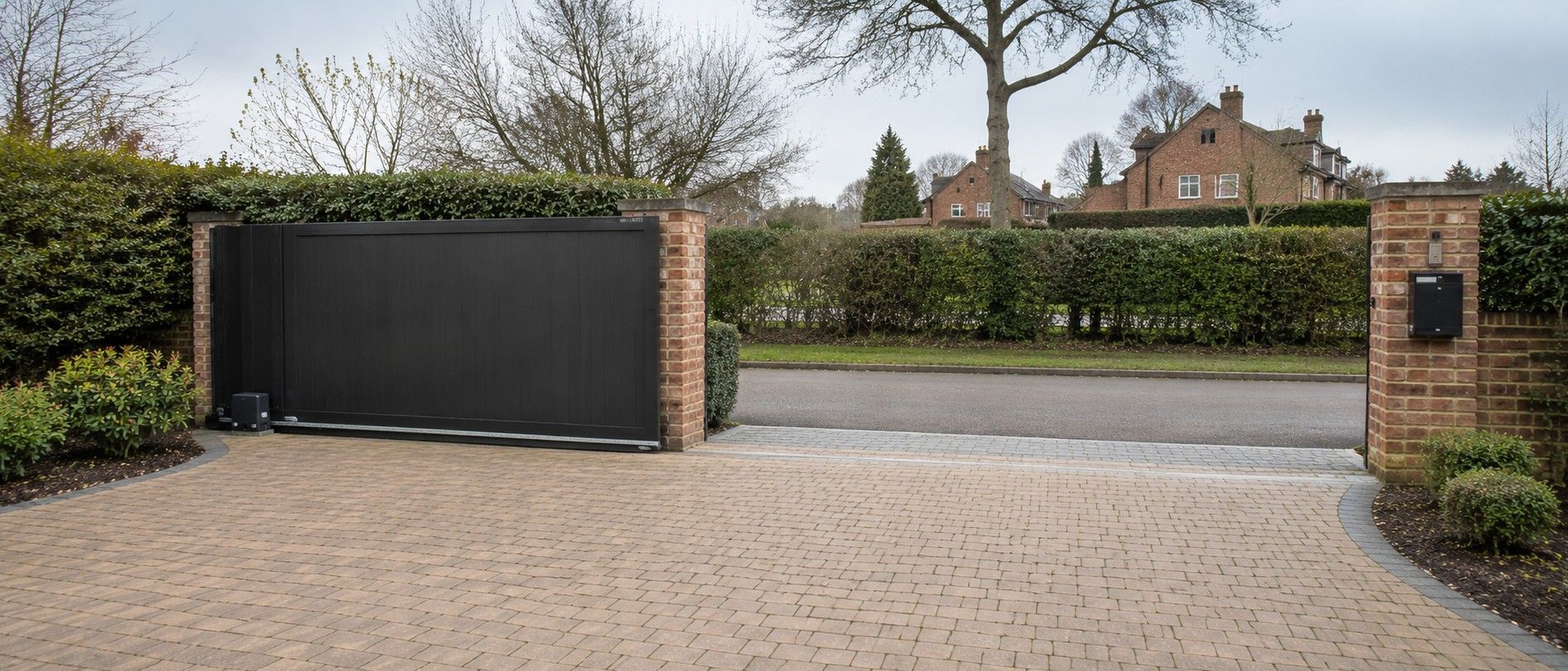
Electric sliding gates open parallel to the fence or wall rather than swinging into the driveway — making them ideal for sloped driveways, narrow plots, wider entrances and any property where swing clearance is limited or unavailable.
What are electric sliding gates?
A sliding gate moves horizontally along a track or frame parallel to the boundary wall, rather than opening inward or outward on hinges. The motor drives the gate leaf along a rack-and-pinion system — no swing space required on either side of the entrance.
There are two main types: tracked sliding gates (gate runs on a ground track with roller wheels) and cantilever sliding gates (gate hangs on a frame and glides over the entrance without touching the ground). Cantilever gates are ideal where the ground surface is uneven or where a clear entrance is important.
Sliding gates are particularly well-suited to wider entrances, commercial properties and any driveway where a swing gate would be impractical. They also open faster than swing gates, making them the preferred choice for high-use entrances.
⚡ELECTRIC SLIDING GATES
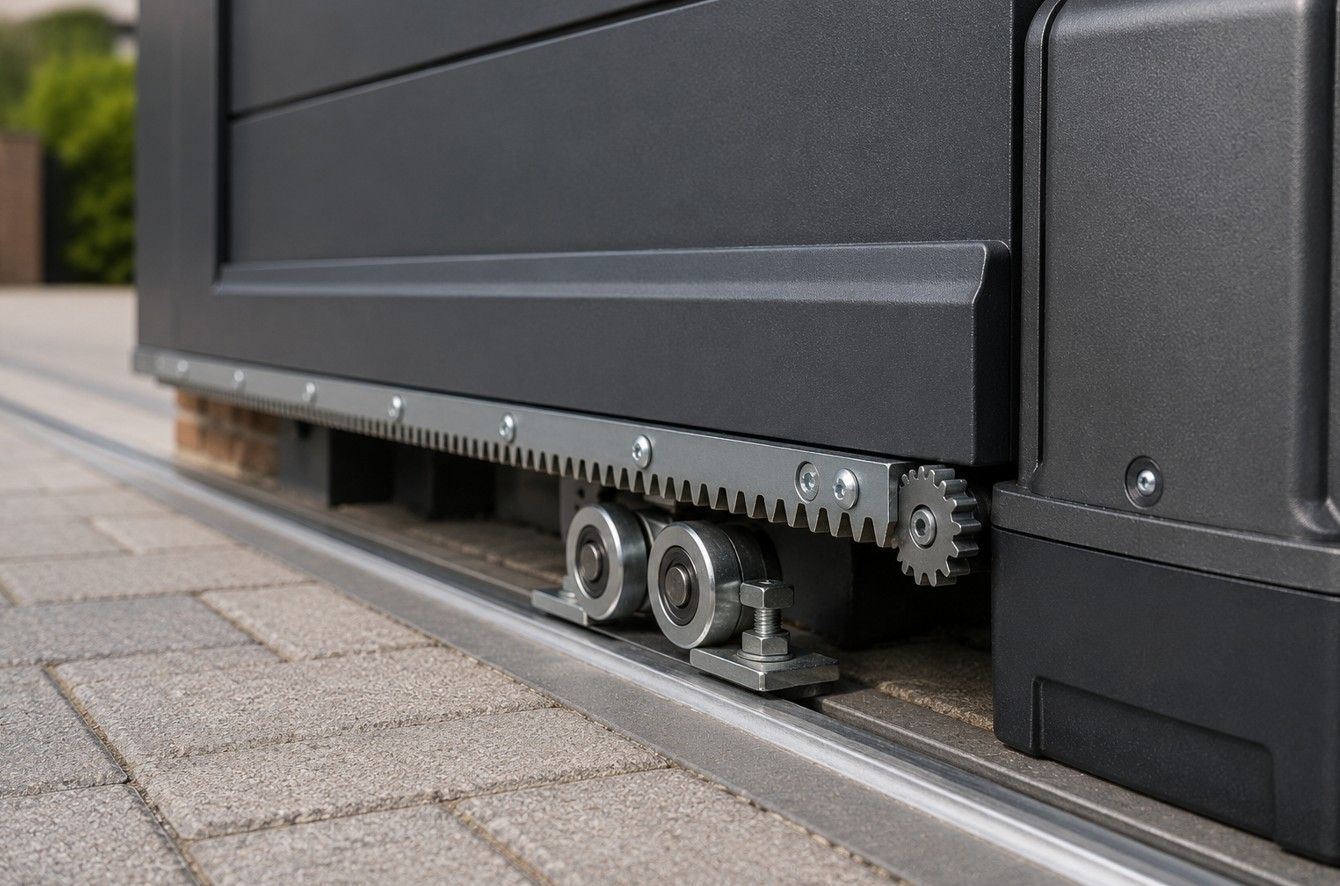
Sliding gate on track
Bottom of an electric sliding gate showing the ground track, roller wheels and rack-and-pinion drive mechanism.
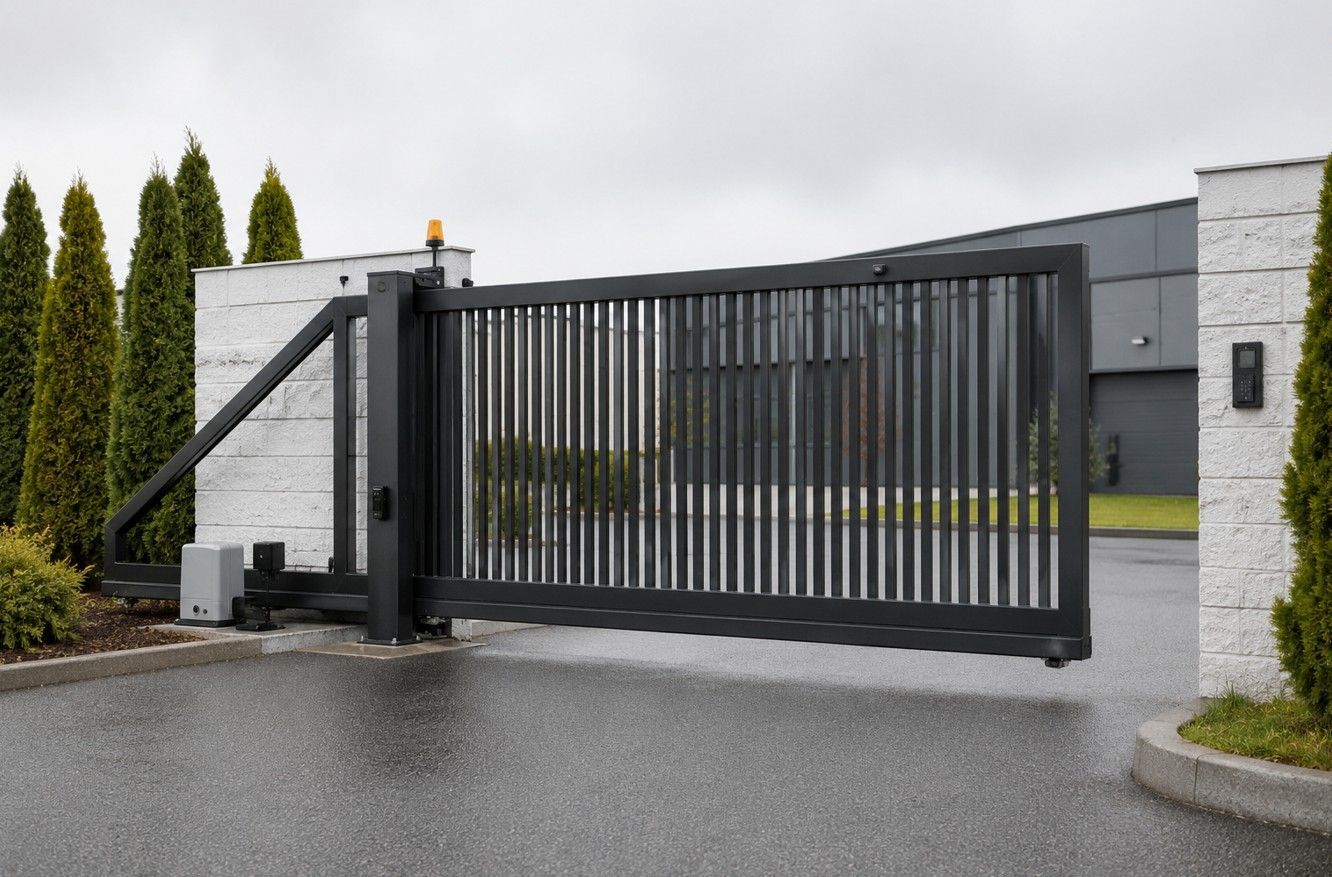
Cantilever sliding gate
Gate slides on a cantilevered frame, hovering above the entrance surface
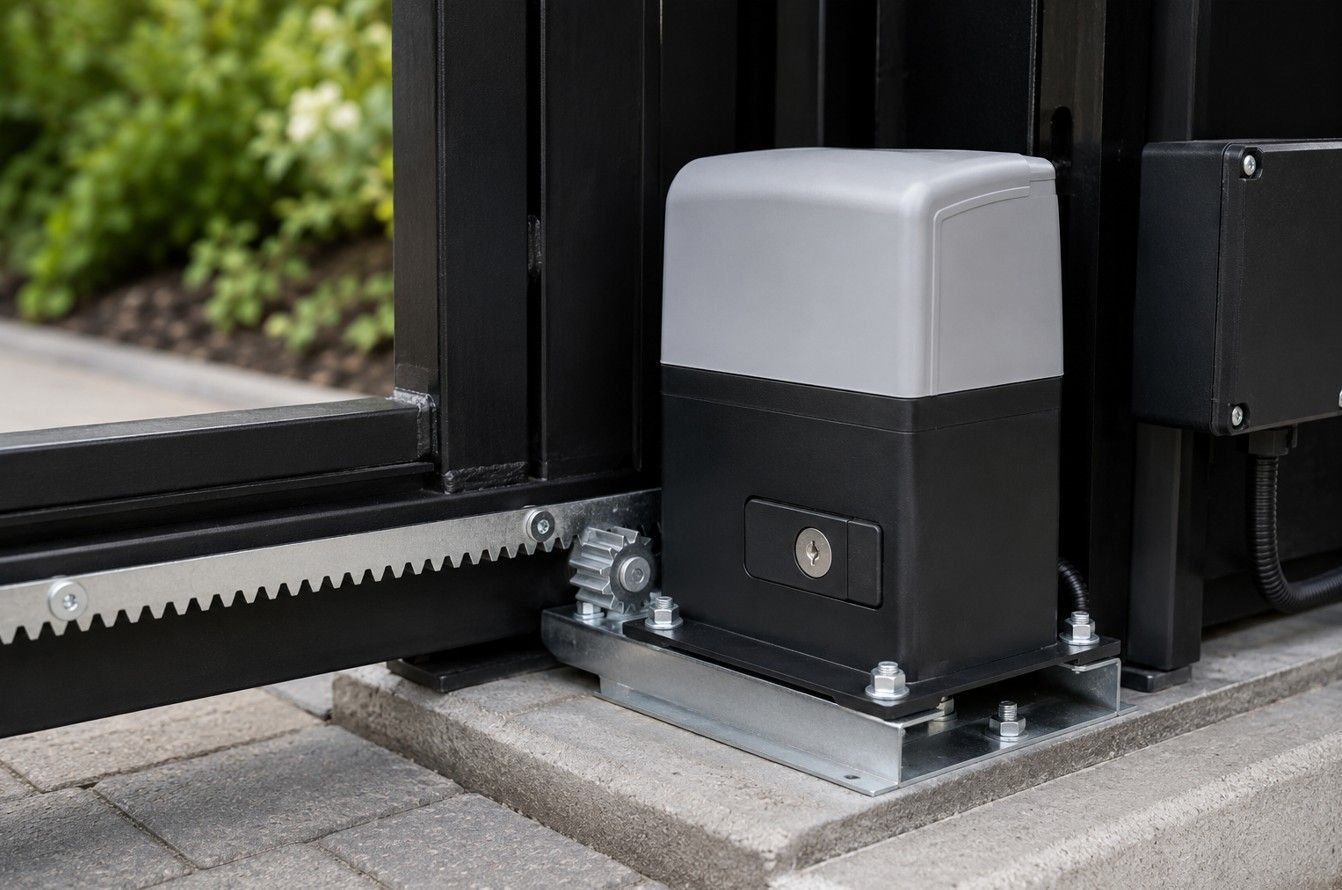
Motor unit close-up
Electric sliding gate motor unit mounted at the base of the gate poste
Which type of sliding gate is right for your property?
Both types operate the same way but suit different site conditions. Your installer will recommend the most practical option at survey stage.
Not sure which is right for your property? Your installer will assess the entrance, ground conditions and available space at survey stage and recommend the most practical option. Submit an enquiry →
When is a sliding gate the right choice?
Sloped driveway
If your driveway slopes toward the entrance, swing gates become very difficult to operate cleanly — the geometry of the swing conflicts with the slope. A sliding gate avoids this problem entirely.
Limited swing clearance
If there is a wall, post, parked vehicle or public path immediately inside or outside the entrance, a swing gate may not have room to open fully. A sliding gate needs only side clearance, not forward clearance.
Wider entrances
Sliding gates can span wider openings than swing gates without the structural challenges of very large hinged leaves. For entrances over 5m, sliding is often the more practical solution.
Speed of access
Sliding gates typically open faster than swing gates — an important factor for commercial properties or households with frequent arrivals and departures.
Still unsure? Send us photos and measurements of your entrance and our local installer will advise on the best gate type for your specific layout.
Get Expert Advice →Automation options for sliding gates
Sliding gates use a rack-and-pinion motor drive. Three levels of automation are available — from basic fob operation to full smart home control. See full pricing guide →
Basic
- · Photocell safety beams
- · 2x wireless remote fobs
- · 8-parameter control board
- · Gates up to 3m wide
Intermediate
- · 2–4x photocell beams
- · 4–6x safety edges
- · 4+ wireless remote fobs
- · GSM phone control with SIM
- · 24v digital MAG lock
- · Gates up to 5m wide
Advanced
- · Wireless photocell beams
- · In-ground vehicle detection loop
- · Double 24v MAG locks
- · 8+ wireless fobs
- · Mobile app control (multi-user)
- · Gates up to 6m+ wide
⚡ FREQUENTLY ASKED QUESTIONS ABOUT ELECTRIC SLIDING GATES
How much side clearance does a sliding gate need?
A tracked sliding gate typically needs a clear run of approximately the same length as the gate itself plus 10–20% extra for the motor and end stops. So a 4m gate needs roughly 4.5–5m of clear boundary alongside the entrance. A cantilever gate needs slightly more due to the counterbalance frame. Your installer will measure this precisely at survey stage.
Can a sliding gate work on a sloped driveway?
Yes — a sliding gate runs horizontally regardless of the driveway slope, making it the preferred solution for sloped entrances. Swing gates can struggle on slopes because the arc of the swing conflicts with the ground plane. This is one of the most common reasons homeowners choose a sliding gate over a swing gate.
What is a cantilever sliding gate and when do I need one?
A cantilever gate glides on a frame above the ground rather than running on a ground-level track. It's the right choice where the entrance surface is uneven, gravelled, ramped or where a ground track would create a trip hazard or obstruction. It's also used where the entrance surface can't be interrupted by a track — such as across a shared access way.
How long does a sliding gate take to open?
Most residential sliding gates take 10–20 seconds to open fully depending on the gate width and motor speed. Commercial operators often specify faster motors. Your installer can advise on motor speed options at survey stage.
How much do electric sliding gates cost?
A complete electric sliding gate installation including gate, motor and Level 1 automation starts from around £3,500 for smaller entrances. Mid-range installations with Level 2 automation run from £6,000 to £8,000 depending on gate width. See our full cost guide for a complete breakdown.
Do sliding gates work in a power cut?
Yes — all systems include a battery backup that maintains operation during short power outages, and a manual release mechanism so the gate can be pushed open by hand if needed. Your installer will demonstrate the manual release at handover.
Find your local fabricator
Choose your region to see every town we cover, or go straight to one of our busier locations below.
By region
Popular locations
Don’t see your town? Every location we cover is listed on our areas we cover page, or send us your postcode and we will confirm.