
Cantilever Gates
Supplied & Installed
A cantilever gate slides across the opening without touching the ground. There is no track to lay across your driveway, nothing to fill with leaves, grit or snow, and nothing to jam when the ground moves. For a lot of entrances it is the better sliding gate — provided you have the room alongside.
Cantilever gates in place
The difference is easier to see than to describe. There is no track across the entrance, and nothing bearing on the ground at all.
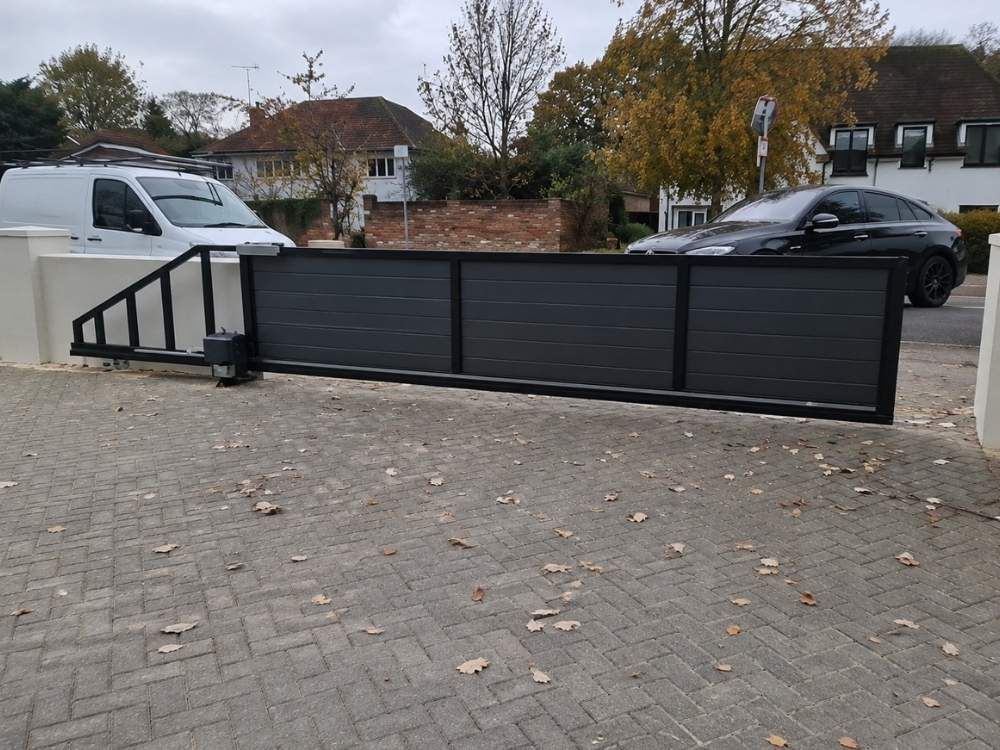
Looks like any sliding gate from the front — until you notice there is nothing running across the driveway.
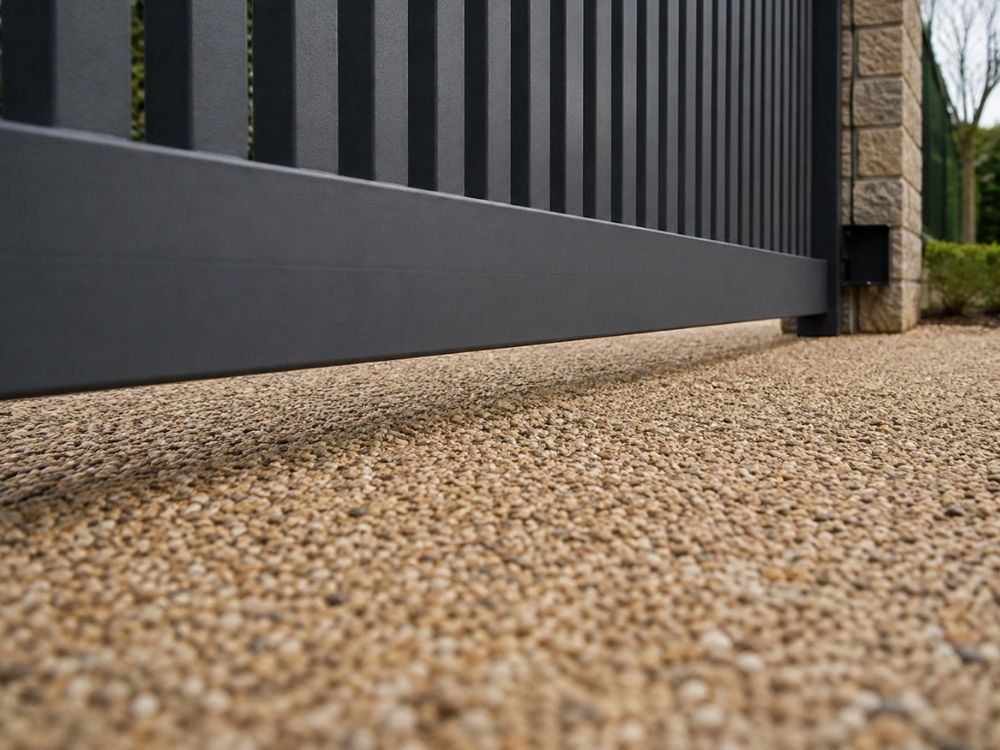
No channel collecting grit and leaves, and nothing to seize when water gets in and freezes.
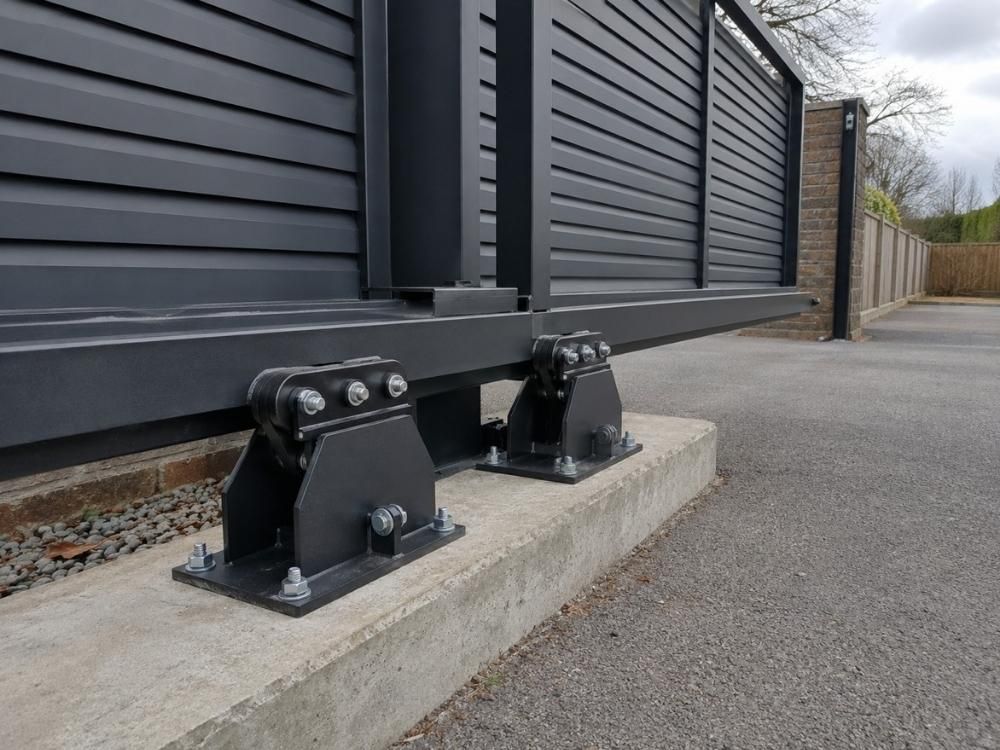
The counterbalance rides on roller carriages set back from the opening, bolted to a reinforced foundation.
What is a cantilever gate?
A conventional sliding gate runs on a steel track set into the driveway, with wheels underneath carrying the weight. A cantilever gate carries no weight on the ground at all. Instead the gate has a counterbalance section extending beyond the opening, and that section rides on two roller carriages bolted to a concrete foundation set back from the entrance.
The result is that the gate leaf floats across the opening with a small gap beneath it. Nothing crosses the driveway, so there is no track to sweep out, no channel filling with grit and leaves, and nothing to seize when water gets in and freezes.
The trade-off is space and foundation. The counterbalance means the gate is longer than the opening it covers, and it needs somewhere to go. It also needs a properly engineered concrete base for the carriages, because everything is bearing on those two points rather than spread along a track.
As a working guide, a cantilever gate needs a clear run-back alongside the opening of roughly 1.5 times the opening width.
So a 4 metre entrance needs around 6 metres of clear space to one side — no wall, no planting, no parked car, nothing the gate would strike as it opens.
If you do not have that, a tracked sliding gate needs less, and swing gates or bi-folding gates need none at all. Worth measuring before you get attached to the idea.
Cantilever or tracked sliding?
Both slide rather than swing. The difference is whether the weight sits on the ground or behind the opening, and that changes what each one suits.
| Cantilever | Tracked sliding | |
|---|---|---|
| Ground track | None. Nothing crosses the driveway. | Steel track set into the surface across the full opening. |
| Space needed | Around 1.5× the opening width, clear to one side. | Around 1.1× the opening width, clear to one side. |
| Uneven or sloping ground | Handles it well — the gate never touches the ground. | Needs a level, consistent run for the track. |
| Debris, snow and ice | Unaffected. Nothing to fill or freeze. | Track needs keeping clear or the gate will jam. |
| Groundwork | Substantial reinforced foundation for the roller carriages. | Track bedded across the opening, lighter foundation. |
| Cost | Higher — more steel, heavier frame, bigger foundation. | Lower for the same opening width. |
| Best for | Uneven ground, harsh winters, wide commercial entrances, anywhere a track would be a nuisance. | Level ground, tighter side space, and where budget matters more than maintenance. |
When a cantilever gate is the right answer
Ground that moves or slopes
A track needs a level, stable run. On ground that heaves, settles or falls away across the entrance, a track will eventually go out of true and the gate will bind. A cantilever gate is indifferent to what the surface does.
Hard winters
Snow, ice and road grit all end up in a ground track, and a gate that will not open on a frosty morning is a daily irritation. This is the single most common reason cantilever gates are specified in Scotland and upland areas.
Wide commercial entrances
Yards, depots and industrial units where lorries cross the opening constantly. A track takes a beating from heavy axles; a cantilever gate removes that wear point entirely.
Farm and rural entrances
Mud, straw and stones are exactly what a ground track does not want. On working entrances a cantilever gate needs far less attention over its life, which is usually what matters more than the initial cost.
How much do cantilever gates cost?
A cantilever gate costs more than a tracked sliding gate of the same width. There is more steel in the frame because of the counterbalance section, and the foundation for the roller carriages is a bigger piece of groundwork than bedding a track.
Where it pays back is over the life of the gate. There is no track to clear, no channel to keep free of grit, and nothing that stops working the first time it snows.
Prices and minimum specifications vary by region and installer. The ranges below are a starting point — your local page shows the figures for your area, and a precise quote follows a site survey.
Full cost guide →Includes supply, fabrication and installation. Groundwork varies by site and is confirmed at survey.
Frequently asked questions about cantilever gates
How much space does a cantilever gate need?
As a working guide, a clear run-back alongside the opening of roughly 1.5 times the opening width. A 4 metre entrance needs around 6 metres of clear space to one side, with no wall, planting or parked vehicle in the way. If you do not have it, a tracked sliding gate needs less, and swing or bi-folding gates need none.
Why is a cantilever gate more expensive?
Two reasons. The gate itself is longer than the opening because of the counterbalance section, so there is more steel in it. And the roller carriages carry the entire weight on two points, which needs a substantial reinforced concrete foundation rather than a track bedded across the opening.
Will it work in snow and ice?
That is one of the main reasons people choose them. A ground track fills with snow, grit and leaves, and a gate that will not open on a frosty morning quickly becomes a daily nuisance. A cantilever gate has nothing at ground level to obstruct, so winter makes no difference to it.
Can a cantilever gate be fitted on sloping ground?
Generally yes, and this is where it has a real advantage. Because the gate never touches the ground, a fall across the entrance is not the problem it would be for a tracked gate. What does need to be level and stable is the foundation the carriages sit on, which is set back from the opening and can usually be worked with.
Is it as secure as a tracked sliding gate?
Yes. The gate leaf and infill are built the same way; the difference is purely how the weight is carried. If anything the foundation on a cantilever installation is more substantial, since everything bears on the two carriage points.
Do cantilever gates need much maintenance?
Less than a tracked gate, which is much of the point. There is no track to keep clear. The roller carriages need checking and lubricating annually along with the motor, safety edges and photocells — the same annual maintenance visit any powered gate should have.
Not sure a cantilever gate suits your entrance?
Tracked sliding gates
Needs less side space and costs less. The right answer on level, stable ground.
Sliding gates →Swing gates
No side space needed at all, provided there is depth on the property for the leaves to open.
Swing gates →Bi-folding gates
Halves the space each leaf needs. Useful where the driveway is short and there is no room to slide.
Bi-folding gates →Rising bollards
No clearance needed in any direction, and nothing visible when lowered.
Bollards →Send us the width of your opening and roughly what space you have to one side, and your local fabricator will tell you honestly which of these will actually work.
Find your local fabricator
Choose your region to see every town we cover, or go straight to one of our busier locations below.
By region
Popular locations
Don’t see your town? Every location we cover is listed on our areas we cover page, or send us your postcode and we will confirm.